Re: Societal collapse
URL: http://friam.383.s1.nabble.com/Societal-collapse-tp7597392p7597394.html
J -
I appreciate the link to the Nature article... I particularly liked the caution about misuse of the "Retrospectoscope" , and the reference to Hari Seldon and PsychoHistory. "... societal spasms are cyclic" seems nearly tautological, but a good reminder. I appreciate that many are now treating global socio-economic-political systems (coupled with the earth-systems) as a truly complex system as best they can.Is it possible to create agent-based models of societal collapse? This Nature article argues human societies have mind- boggling complexity, but I am not so sure if it is impossible.
Of course it is possible to build an ABM in this domain... bit
as the article gestures toward, there is no bottom to the possible
complexity (at least down to Glen's previous reminders to us that
our individual microbiome is a key part of our "selves" in more
ways than simply accounting for body mass or cell count).
Unfortunately we aren't just dealing with the risk of our
multiple (highly coupled, but nevertheless diverse) facets of
societies and whole societies collapsing and taking one another
down like dominoes (or a house of cards), but the earth-systems
our high-tech, energy-and-minerals-and-plant-products-hungry
society depends on being able to draw from (exploit?).
We looked at an SEIR/ABM covid-model for NM at the individual
level which seemed (barely) tractable on a single machine (memory
size)... I have worked with Systems Dynamics models which are
highly aggregative and we even ran 100,000 samples from the World3
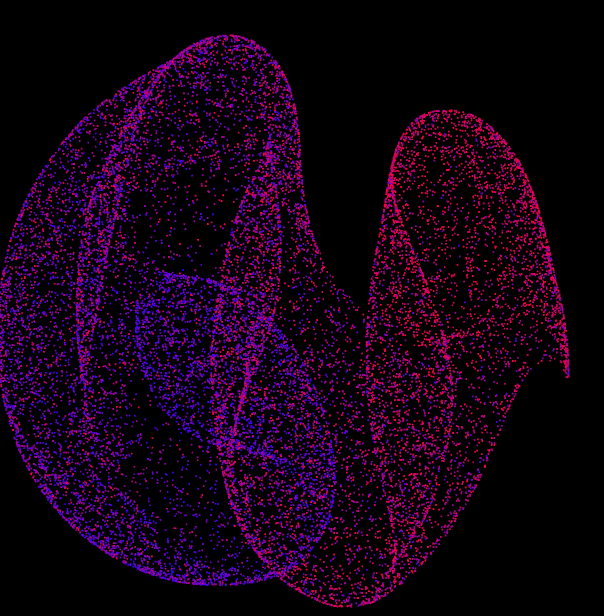
model from 1900-2100 as a test/demonstration last year. The
World3 model focuses on Economics and Resource Utilization and was
conceived around the idea of "Limits to Growth"... it doesn't
really do justice to more subtle societal issues (like social
justice, massive political shifts, personal violence, etc.)
Within the 10^5 parameter sweep we started with there are
(naturally) large subregions where human life becomes acutely
miserable. There are lots of criticisms of the model and it IS
very long of tooth.
I'd be interested if anyone knows of ABMs or Discrete Event
Simulations that aspire to study more than the smallest of
subsets.
Our experiments with World3 were as much about studying high
dimensional ensemble-problem sets where intuition can be used to
double-check the results, as it was about the problem domain of
impending collapse.
- .... . -..-. . -. -.. -..-. .. ... -..-. .... . .-. .
FRIAM Applied Complexity Group listserv
Zoom Fridays 9:30a-12p Mtn GMT-6 bit.ly/virtualfriam
un/subscribe http://redfish.com/mailman/listinfo/friam_redfish.com
archives: http://friam.471366.n2.nabble.com/
FRIAM-COMIC http://friam-comic.blogspot.com/
| Free forum by Nabble | Edit this page |