Re: Climate Change
Posted by Pieter Steenekamp on
URL: http://friam.383.s1.nabble.com/Climate-Change-tp7590999p7591025.html
============================================================
FRIAM Applied Complexity Group listserv
Meets Fridays 9a-11:30 at cafe at St. John's College
to unsubscribe http://redfish.com/mailman/listinfo/friam_redfish.com
FRIAM-COMIC http://friam-comic.blogspot.com/ by Dr. Strangelove
URL: http://friam.383.s1.nabble.com/Climate-Change-tp7590999p7591025.html
Marcus,
I do think we are not on the same page.
I compare predictions against actuals.
In 1990 their predictions proved to be wrong. You are showing me their current predictions. If they were wrong with their confident predictions in 1990, how come they are right now?
I am not over the moon enthusiastic about people having made wrong predictions and then come up with new of the same predictions. Show me where your predictions proved to be right.
On 29 December 2017 at 21:46, Marcus Daniels <[hidden email]> wrote:
"In 1990 the IPCC predicted a temperature increase of 0.3 degrees centigrade per decade. In 2014 they reported an actual increase of 0.05 degrees centigrade for the previous 15 years."
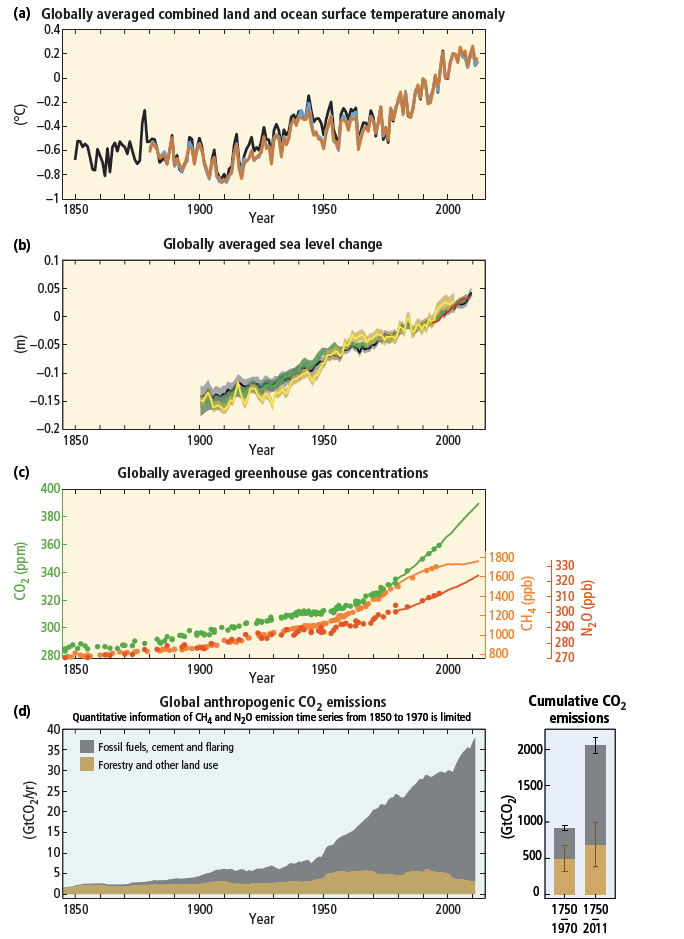
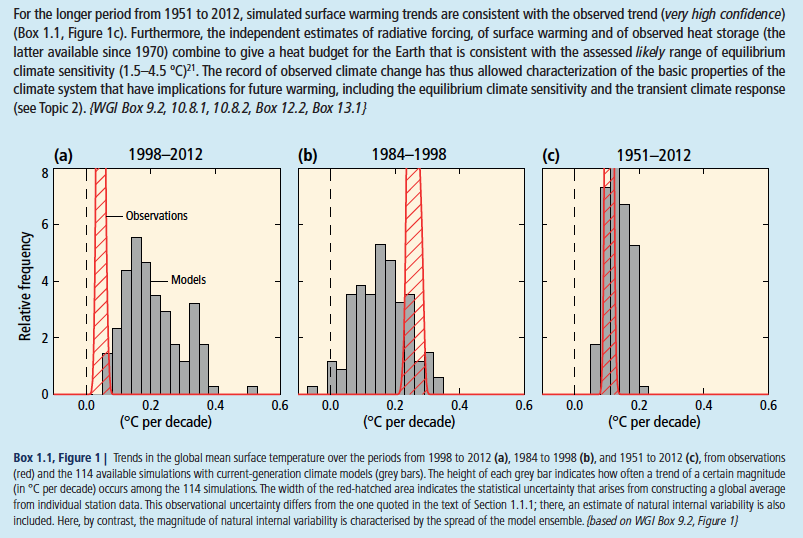
The second plot gives an idea of how these estimates, based on observation, could go wrong. However, the first plot in the first image shows a trend over a larger interval, which is consistent with matching the observational & simulation outputs for longer periods.
From: Friam <[hidden email]> on behalf of Pieter Steenekamp <[hidden email]>
Sent: Friday, December 29, 2017 12:16:38 PM
To: The Friday Morning Applied Complexity Coffee Group
Subject: Re: [FRIAM] Climate ChangeThank you, I do appreciate.
Let me start with my background. I have done modeling for predictions in engineering applications as a major part of my professional career of 40 years. I am now doing deep learning for making predictions. (Not necessarily relevant to this discussion, but I do combine ABM to get the emerging properties of the system as part of the deep learning exercise - a very exciting endeavor).
In my career, I have made many technical mistakes. I guess this is part of making predictions based on models. I do not have any climate modeling expertise, but I do measure their success in the accuracy of the model's predictions.
In 1990 the IPCC predicted a temperature increase of 0.3 degrees centigrade per decade. In 2014 they reported an actual increase of 0.05 degrees centigrade for the previous 15 years.
Maybe they are right in their new disaster predictions? IMO it would give them some credibility if they admit the uncertainties.
On 29 December 2017 at 20:44, uǝlƃ ☣ <[hidden email]> wrote:
Yes, I think so. The trick, I think, is to demonstrate respect for those with whom we disagree. If someone posts, without rancor, an argument (preferably with data) arguing that the models are wrong in a crucial way, I know *I* would be interested.
I've posted tons of contrarian and stubborn, perhaps even stupid, opinions and have been treated with respect.
On 12/29/2017 10:34 AM, Pieter Steenekamp wrote:
> Is it possible to have, in this group, a civil discussion where the accepted view of the IPCC that unless we reduce CO2 emissions we are heading for disaster is challenged?
--
☣ uǝlƃ
============================================================
FRIAM Applied Complexity Group listserv
Meets Fridays 9a-11:30 at cafe at St. John's College
to unsubscribe http://redfish.com/mailman/listinfo/friam_redfish.com
FRIAM-COMIC http://friam-comic.blogspot.com/ by Dr. Strangelove
============================================================
FRIAM Applied Complexity Group listserv
Meets Fridays 9a-11:30 at cafe at St. John's College
to unsubscribe http://redfish.com/mailman/listinfo/friam_redfish.com
FRIAM-COMIC http://friam-comic.blogspot.com/ by Dr. Strangelove
============================================================
FRIAM Applied Complexity Group listserv
Meets Fridays 9a-11:30 at cafe at St. John's College
to unsubscribe http://redfish.com/mailman/listinfo/friam_redfish.com
FRIAM-COMIC http://friam-comic.blogspot.com/ by Dr. Strangelove
| Free forum by Nabble | Edit this page |