Re: particles have free will
URL: http://friam.383.s1.nabble.com/particles-have-free-will-tp2655680p2657079.html
Occam must be holding his head.
-- Russ
Particle decay is easy to explain if you assume a multiverse. And when you do, the “free will” disappears.
A multiverse theory today is difficult to swallow for the same reasons that the heliocentric theory, evolution, and relativity were difficult to swallow:
(1) We haven’t evolved to sense these theories in action. We don’t sense the Earth moving, species evolving, space warping, or time dilating. We have to use our minds.
(2) These theories diminish our ego’s desire to feel unique and special. We’re NOT the center of the universe. We’re NOT so different than other animals. We HAVEN’T been here forever.
(3) Such large numbers make us feel small. A few heavenly bodies vs. 10e21stars in the visible universe. 6000 years old vs. 14 billion years. 100 types of animals on the Arc vs. millions.
In a multiverse, we cannot sense the OTHER copies of ourselves in other parallel universe. We cannot sense our bodies and consciousness splitting each time any quantum particle splits into a finite set of states. If it WERE true, then we’d not be very special. Having 10e80 elementary particles in the universe is quite a big number. Now raise that to the power 10e60 Planck time units since the universe began, and raise it again to the average number of states each particle can have, and we end up with numbers far beyond our comfort zone. Interesting though, we seem to be more comfortable with an “infinite” number of family of curves generated by f(x) = c * x than we do with a large, but finite number of curves generated by the grand equation of the universe.
But many people do have the ability to make a hypothetical assumption. Suppose our conscious bodies do split with the universe every time any particle changes state. The multiverse theory says that if a particle CAN switch to N possible “next” states, then the particle DOES switch to ALL those states simultaneously – each in its unique universe, which then resembles a big static deterministic probability decision tree. There’s a Pauli-exclusion-like principle here where no two universes can have the same exact total state.
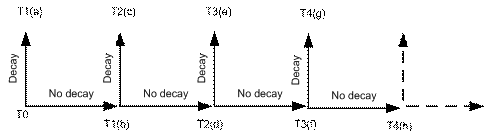
So suppose we are at time T0 in the diagram below observing an elementary particle. It can decay or not decay. In the multiverse, it does both. We at T1 in universe (a) say, “Hmm, why did it ‘choose’ to decay this time?” Our counterparts in T1 universe (b) say “Hmm, why didn’t ‘choose’ to decay this time?” Both equally confused because neither see the other part of the elephant. Once a particle decays, it pretty much stays that way forever so our observation experiment is deemed “done”. It’s only when it doesn’t decay that we continue observing.
Assuming we’re the only ones in a single universe (because we “feel” it so) leads to a paradox. We never understand why particles decay? We project “intelligence” and “free will” and “choice” into these particles just like we projected “femininity” into Luna before we understood astrophysics.
But when we make the leap of faith and, with our minds, step out of all the universes looking in on them all at once; only then do the particles becomes predictable, mundane deterministic machines that splits every M Planck time units. The bigger the M; the long the half-life!
Notice that this diagram easily predicts that we would observe an unpredictable decay at any point in time, but statistically observe an exponential decay with a half-life over any length of time. The half-life is equal to the length of any one arrow.
One big problem I have with my own hypothesis is that it leads us to think that each particle might have some type of counter inside it that, like an alarm clock, that ticks up to some amount of time and then splits. But there are other ways to resolve this… (later).
Robert Howard
From: [hidden email] [mailto:[hidden email]] On Behalf Of Nicholas Thompson
Sent: Saturday, April 18, 2009 10:55 AM
To: [hidden email]
Subject: Re: [FRIAM] particles have free will
This is the sort of thing that drives behaviorists to be tower murderers.
"It asserts, roughly, that if indeed we humans have free will, then elementary particles already have their own small share of this valuable commodity."
First, what kind of a syllogism is this?
Second, valuable to whom? For what?
Third, assertions of free will in anything .... even humans --are not consistant with materialism. Materialism is the doctrine that everything that is real consists of matter and its relations.
Beyond materialism is only madness.
Free will is just a legal doctrine that allows us to kill people when they do something we dont like.
Nick
Nicholas S. Thompson
Emeritus Professor of Psychology and Ethology,
Clark University ([hidden email])
----- Original Message -----
From: [hidden email]
To: [hidden email]
Sent: 4/18/2009 8:28:20 AM
Subject: [FRIAM] particles have free will
According to Conway (Game of Life inventor), particles have free-will. See http://kk.org/ct2/2009/03/particles-have-free-will.php for a summary and http://www.ams.org/notices/200902/rtx090200226p.pdf for the paper.
Seems that every time I turn Netlogo off, I'm committing murder....
Robert
============================================================
FRIAM Applied Complexity Group listserv
Meets Fridays 9a-11:30 at cafe at St. John's College
lectures, archives, unsubscribe, maps at http://www.friam.org
============================================================
FRIAM Applied Complexity Group listserv
Meets Fridays 9a-11:30 at cafe at St. John's College
lectures, archives, unsubscribe, maps at http://www.friam.org
| Free forum by Nabble | Edit this page |